INTRODUCTION
Common Name: Uniconazole 5% WP
Use: Used to reduce lodging in rice; to reduce vegetative growth and increase flowering of ornamentals; and to reduce vegetative growth and the need for pruning in trees.
Company Name: Penzeal Industry Co., Ltd.
Situation : Asia
Nationality : China
Address : Rm.709 East Block Huatai Zonghe Building, No.76 Xinwen Road, Futian District, Shenzhen, P. R. China
Remarks : Penzeal Industry Co., Ltd. is a specialized formulation factory in the field of agrochemical products. We possess very strong networks of relationships, complete techniques and staffing. We own a very professional team, whose members have been engaged in agrochemical products for more than 10 years. We have established long-term and good co-operation with most outstanding technical factories in China, so we are fully confident to offer products with good quality but low price to our esteemed customers. In terms of shipment, we have very perfect Export service system, and have established good relationship with many shipping and air companies, so that we can choose the best shipping or air lines for your goods to different countries and areas, of course accordingly we offer a series of service including fast custom declaration and insurance.
APPLICANT
Name : Penzeal Industry Co., Ltd.
Address : Rm.709 East Block Huatai Zonghe Building, No.76 Xinwen Road, Futian District, Shenzhen, P. R. China
Nationality : China
Tel. : 86-755-83864316
Authority cert. : We are registered in the Ministry of Agriculture as an Established Company.
Indentity cert. : We are registered in the Ministry of Agriculture as an Established Company.
Remarks : Penzeal Industry Co., Ltd. is a specialized trade company in the field of import & export of agrochemical products. The company possesses very strong networks of relationships, complete techniques and staffing. In respect of products sources, we own a very professional team, whose members have been engaged in purchasing and operation of agrochemical products for more than 10 years. For more, we have established long-term and good co-operation relationship with most outstanding suppliers in China, so we are fully confident to offer products with good quality but low price to our esteemed customers. In terms of shipment, we have very perfect Import & Export service system, and have established good co-operation relationship with many shipping and air companies, so that we can chose the best shipping or air lines for your goods to different countries and areas, of course accordingly we offer a series of service including fast custom declaration and insurance.
Chemistry of The Product
SYNONYMS
Common Name: Uniconazole
Code Number: N/A
Trade Name: Alphamore 5% WP
Initial Regist.: N/A
Chemical Class: (E)-(RS)-1-(4-chlorophenyl)-4,4-dimethyl-2-(1H-1,2,4-triazol-1-yl)pent-1-en-3-ol
Local Synonyms: N/A
Chemical Name:
Source: Uniconazole
Structural Formula:
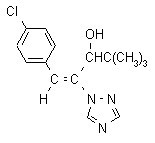
Physical and Chemical Properties:
Molecular Weight: 291.8
Physical Form: Solid
Technical Purity: 90%
Vapour Pressure: 8.9 mPa (20oC)
Colour & Odour: White, odourless
Density: 1.28 (21.5oC)
Solubility: In water 8.41 mg/l (25 oC). In methanol 88, hexane 0.3, xylene 7 (all in g/kg, 25 oC). Soluble in acetone, ethyl acetate, chloroform, and dimethylformamide.
Octanol Number : logP = 3.67 (25oC)
Type of Formulations And Specifications
CONTENTS |
TYPE OF FORMULATIONS |
Wettable powder |
|
|
ACTIVE INGREDIENT
INERT INGREDIENT |
Uniconazole 5%
Dispersant 2%, wetting agent, 2%, filler 91% |
|
|
SPECIFICATIONS OF FORMULATIONS
Appearance : Off-white powder
Alkalinity or Acidity : N/A
Suspensibility : 80% min
Emulsification Properties : N/A
Density : N/A
Viscosity : N/A
Persistent foam : N/A
Flash Point : N/A
Freeze Point : N/A
Wettability : 60 s max
Particle Size : In wet sieve test, 98% max through 75 μm sieve
Compatability : Incompatible with strong acid or alkaline agrochemicals
Heat Stability : After storage at 54±2 oC for 14 days, the determined average active ingredient content must not be lower than 90% relative to the determined average content found before storage and the product shall continue to comply with pH range, suspensibility and wettability.
Storage Stability : Qualified in storage stability test
Mixing Properties : N/A
Methods of Analysis : GC/HPLC
Levels of Impurities : N/A
Biological Spectrum
Pesticidal efficacy (list of pests):
Used to reduce lodging in rice; to reduce vegetative growth and increase flowering of ornamentals; and to reduce vegetative growth and the need for pruning in trees.
Mode of action:
Plant growth regulator, absorbed by the stems and roots, with translocation in the xylem to growing points.
Use and Recommendations:
Target Pest |
CROP |
APPLICTION RATE / Faddan |
APPLICATION METHOD |
Increase tillers |
Rice |
0.4 – 1.0 ml/L water |
Soak seeds for 36 - 48 h |
Inhibit overgrowing, increase tillers |
Rice |
1.0 - 2.0 ml/L water
|
Foliar spray in 2 – 3 leaves stage |
Increase tillers |
Wheat |
0.2 ml/L water |
Soak seeds for 3 h |
Reduce lodging, increase yield |
Wheat |
1.0 ml/L water |
Foliar spray in 3 - 5 leaves stage |
Inhibit overgrowing |
Rape |
0.8 ml/L water |
Foliar spray in 3 leaves stage |
Inhibit overgrowing, increase yield |
Peanut, soya bean |
1.0 ml/L water |
Foliar spray in the beginning of flowering stage |
Phytotoxicity:
Phytotoxic to plant at overhigh dosage.
PHI:
Rice 5 d, wheat 5 d, soya bean 5 d, peanut 3 d
Toxicological Studies
Acute Mammalian Toxicity:
Acute toxicity |
ANIMAL |
LD50 mg/Kg body weight |
Technical |
Form |
Oral
Dermal
Inhaltion (mg/m3/2H) |
Rat
Rabbit
Rat |
1790-2020
>2000
2750 |
>2000
>2000
>2000 |
Symptoms |
EYE: Slightly irritating |
SKIN: Non-irritating |
WHO
Classification |
Toxicity Category |
Label Signal Word |
High I |
Mod II |
Low III |
Danger |
Warning |
Caution |
Techn.
Form
Impurities |
|
|
III
III
III |
|
|
CAUTION
CAUTION
CAUTION |
Chronic Toxicity
The requirement for a chronic oral dog study has been satisfied. The no-obserbed-effect-level (NOEL) is 2 mg/kg/day and was based upon increased liver weights in male dogs. Liver weight also was increased in male and female dogs at 20 mg/kg/day and correlated with hepatocellular enlargement, increased cytoplasmic homogenity and increased bile pigment. The LOEL is 20 mg/kg/day and was based on increased liver weight.
Carcinogenicity (WHO-IARC)
In an 18-month mouse oncogenicity study, administration of uniconazole to Cr1:CD-1 mice at doses of 0, 10, 40, 200, or 1500 ppm (0, 1.5, 6, 30 and 225 mg/kg/day) resulted in a systemic NOEL of 30 mg/kg/day, and a LOEL of 225 mg/kg/day. These were based on icreased absolute and relative liver weights in in males, and increased relative liver weights in female, accompanied by focal chronic inflammation, necrosis, and pigmented macrophages. The HED Carcinogenicity Peer Review Committee evaluated the compound and classified Uniconazole as a Group C, possible human carcinogen. The classification was based upon an increased incidence of hepatocellular adenomas, carcinomas and adenomas/carcinomas combined in high dose male CD-1 mice. Quantification using the low dose extrapolation model was not recommended because the tumor induced was primarily of benign natrure, occurred only at the highest dose tested, and occurred in only one sex of one species. Therefore, the Reference Dose (RFD) approach will be used for the estimation of potential human risk for future registrations involving food/feed uses.
Delayed neurotoxicity (WHO)
No data available
Hormonal disruption (WHO)
No effect on hormone.
Teratogenicity & Reproduction (WHO)
In a two generation reproduction study, rats were fed doses of 0, 15, 150, or 1500 ppm (daily doses of approximately 0, 0.72, 7.5, and 75 mg/kg/day). The NOEL for systemic toxicity is 7.5 mg/kg/day, based on increased liver weight, liver hypertriphy and vacuolization. The reproductive toxicity NEOL is 7.5 mg/kg/day, based on reduced pup weight during lactation. The LOEL was 75 mg/kg/day based on reduced pup body weight during lactatation. There was no other evidence of reproductive toxicity.
Mutagenicity (WHO)
No mutagenic activity was ovserved when tested in five strains (TA1535, TA1537, TA1538, TA98 and TA100) of Salmonella typhimurium or in E.coli with and without metabolic activation. The in vitro chromosomal abberration test indicated negative responses without activation at several concentrations of up to and including 2×10⁻⁴ M, but was positive when tested with activation at up to 3×10⁻⁴ M. In vitro testing in Chinese hamster ovary (CHO) cells was postive when tested with S-9 activation. Uniconazole tested slightly postitive in DNA damager/repair assay and mouse activation micronucleus tests; however, these were graded unacceptable but upgradeable.
ECOTOXICOLOGY
- Aquatic Organisms
Avian acute toxicity:
Bobwhite quail LD50 1461 mg/kg
Mallard duck LD50 > 2315 mg/kg
Avian dietary toxicity:
Bobwhite quail LC50 > 5782 mg/kg
Mallard duck LC50 3442 mg/kg
Freshwater fish acute toxicity:
Bluegill sunfish LC50 6.80 ppm
Rainbow trout LC50 14.8 ppm
2- Earthworms
Very slightly toxic to earthworms, treatment of soil with levels up to 12x in maximum proposed application rate had no effect on the respiration of soil organisms.
3-Honey bees
The maximum application rate of uniconazole-p of 1.2 kg/ha corresponds to 12 µg/cm2. Assuming that a bee in a spray cloud has a target area of 1 cm2 an exposure level of approximately 12 µg/bee may be expected if uniconazole-p is sprayed at the maximum rate. At the minimum recommended rate (0.6 kg/ha) an exposure rate of 6 μg/bee would be expected. The contact LD50 for bees was >20 µg/bee, with no mortalities observed at test concentrations up to 20 µg/bee. Thus, it is anticipated that bees in the trees at the time of spraying, timed to coincide with flowering, would not receive a lethal dose of uniconazole-p.
4- Birds
As a worst case, assuming that a mallard duck (most sensitive species tested) consumed short range grass treated with the maximum application rate of uniconazole-p as 100% of its diet. Based on estimated residue levels the calculated Q value (EEC/LC50) for mallard duck is < 0.1, indicating an acceptable dietary hazard for birds from uniconazole-p. In addition, avocados do not carry ripe fruit likely to attract birds. Hence, the use of uniconazole-p as proposed is not expected to result in a hazard to birds.
5- Parasites and Predators
It is not dangerous to parasites and predators when used as recommended.
ENVIRONMENTAL CHEMISTRY
Fate in Soil:
In soil photolysis studies using either the triazolyl or phenyl ring labelled uniconazole-p, conducted to meet US EPA requirements, the photo-degradation was much slower. Equilibrium was established between the parent compound and its Z-isomer. At the end of both studies, >70% of the originally applied radiolabel was recovered as unchanged parent and around 10% as the Z-isomer. Half-lives of 140.4 days and 78.5 days were derived by extrapolation of the data..
Effect on microbial Process:
Microbial breakdown in aerobic soils in the dark is slow.
Method of Res.Analysis: GC/HPLC
Fate in Plant:
The metabolism and distribution of uniconazole-p was studied in apples and tomatoes using 14C-uniconazole-p. Apple trees were injected with 25 mg 14C-uniconazole-p and stems and apples harvested 86 days after the injection. Tomatoes were treated with 2 foliar sprays of 14C-uniconazole at 14 day intervals and at a rate of 0.14 kg ai/ha with a PHI of 49 days. Plants were separated into branches/stems, leaves and edible fruit and the radioactive residues characterised by 2-D TLC and HPLC co-chromatography. The major component of the total radioactive residue was parentcompound with minor amounts of the geometric Z-isomer as well as CYC-4Cl and the corresponding conjugates. The major metabolic pathways were E/Z isomerisation followed by cyclisation, hydroxylation at the terminal carbon and conjugation and is shown in the scheme above. In the case of tomatoes oxidation of the hydroxyl group to a ketone also occurred. In summary, in plants the major component of the residue in fruit is unchanged parent compound.
Fate in Water:
Photolysis in water under Australian conditions could be a significant route of degradation, especial for material directly exposed to light. Degradation is expected to be significantly slower for material not directly exposed. Photolysis on soil is not expected to be a significant route of degradation.
Photo degradation Rate:
In soil photolysis studies using either the triazolyl or phenyl ring labelled uniconazole-p, conducted to meet US EPA requirements, the photo-degradation was much slower. Equilibrium was established between the parent compound and its Z-isomer. At the end of both studies, >70% of the originally applied radiolabel was recovered as unchanged parent and around 10% as the Z-isomer. Half-lives of 140.4 days and 78.5 days were derived by extrapolation of the data.
Photolysis in water under Australian conditions could be a significant route of degradation, especial for material directly exposed to light. Degradation is expected to be significantly slower for material not directly exposed. Photolysis on soil is not expected to be a significant route of degradation.
Rate of hydrolysis at PH levels :
In a study conducted according to US EPA Guidelines, there was no hydrolysis at pH 4, 7, and 9 after 30 days at 25°C. Hydrolysis is not expected under normal environmental conditions.
Methods of analysis: GC/HPLC
Fate in Animal:
The animal metabolism of uniconazole was studied in rats. On single dosing of male and female rats orally with 14C-uniconazole at 1 or 200 mg/kg bw, nearly 100% of the dose was excreted in faeces (34-59%) and urine (40-67%) within 7 days. Peak tissue concentrations were attained 1 to 8 hours post-dose. The adrenal gland and liver had the highest peak concentrations of radioactivity for any tissue, 4.57 and 2.59 mg equiv./g for adrenal and liver respectively. The major component of the residue in liver was unchanged parent compound. Recoveries of radioactivity with methanol from blood, kidney and liver were 76-99.1%. The half-lives for radioactivity in liver, kidney and adrenal gland were 5.5, 8.5 and 9.5 hours respectively.
SAFETY HANDLING STORAGE AND DISPOSAL
Storage:
Requirements for storage areas and containers
Keep out of the reach of children.
Advice on common storage
Keep away from food, drink and animal feedingstuffs.
Suitable materials
Rigid material with protection against moisture.
Shelf Life:
2 years.
Handling Precautions:
Avoid contact with eyes, prolonged contact with skin, and inhalation of the vapour. Use with adequate ventilation. Wash hands before eating, drinking, chewing gum, smoking, or using the toilet. Remove clothing immediately if the insecticide gets inside. Then wash skin thoroughly using a non-abrasive soap and put on clean clothing. Do not apply directly to areas where surface water is present, or to intertidal areas below the mean high water mark. Water used to clean equipment must be disposed of correctly to avoid contamination.
Containers (Lining):
100 g, 250 g, 500 g, 1 kg aluminium bag, 25 kg fiber drum. Or other packing according to equirement.
Signs and symptoms of Over Exposure:
Dizziness, headache, nausea, abdomen convulsion, vomit, hidrosis, myosis, weep, spit hypersecretion, can cause lethal danger if contact or inhale to much directly.
Note to Physician:
No special advice. Treat symptomatically.
FIRST AID:
IF Swallowed:
If the victim is convulsing or unconscious, administer a glass of water, ensure that the victim's airway is open and if symptoms developed, call a physician immediately..
If in eyes:
Hold eye open and rinse slowly and gently with water for 15 to 20 minutes. Remove contact lenses, if present, after the first 5 minutes, then continue rinsing eye. Call a poison control center or doctor for treatment advice.
If on skin or clothing: Take off contaminated clothing. Rinse skin immediately with plenty of water for 15-20 minutes. Call a poison control center or doctor for treatment advice.
IF Inhaled
If person is not breathing, call an ambulance, then give artificial respiration, preferably mouth-to-mouth if possible. Call a poison control center or doctor for further treatment advice. Take affected person to fresh air.
ANTIDOTE:
No special antidote.
Administer glasses of water if swallow.
REMARKS:
The information above is believed to be accurate and represents the best information currently available to us. However, we make no warranty of merchant ability or any other warranty, express or implied, with respect to such information, we assumes no legal responsibility for use or reliance upon these data. The date on this sheet relates only to the specific material designated herein, and users should make their own investigations to determine the suitability of the information for their particular purposes.
|